
Transcript
Announcer:
You’re listening to VacciNation on ReachMD. This episode is sponsored by CSL Seqirus. Here’s your host, Dr. Jennifer Caudle.
Dr. Caudle:
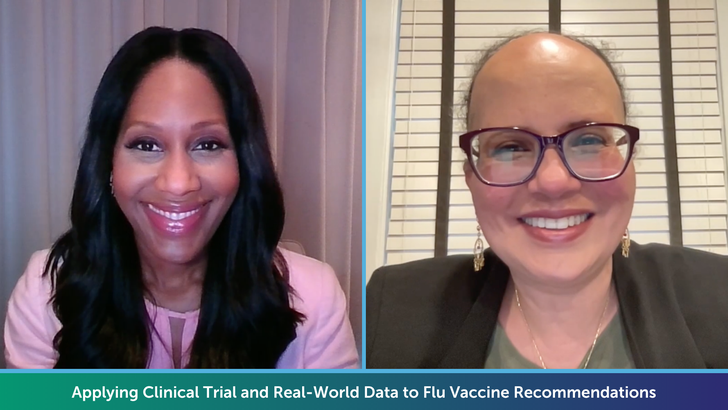
Welcome to VacciNation on ReachMD. I'm your host, Dr. Jennifer Caudle, and joining me to discuss the role of clinical trial data and real-world evidence in informing annual influenza vaccination is Dr. Kawsar Talaat. She's an Associate Professor in the Department of International Health at the Johns Hopkins Bloomberg School of Public Health in Baltimore, Maryland. She also serves as a Johns Hopkins PI for the CDC Clinical Immunization Safety Assessment Project. Dr. Talaat, thank you so much for being here today.
Dr. Talaat:
Thank you very much, Dr. Caudle. It's my pleasure.
Dr. Caudle:
Of course. And before we dive into the data, let's set the stage. So every flu season adds a new layer of effectiveness data to the picture. As you look at where the evidence stands today, how does that shape the way you think about flu vaccination heading into a new season?
Dr. Talaat:
So what I see is that flu vaccine effectiveness against illness varies from year to year, and we learn this by both the clinical trials that are done in controlled settings, but also by real-world effectiveness studies that are done by large consortia that look at vaccine effectiveness in different settings.
But, in addition to that, we are also learning every year about the impact that influenza vaccination has on things that we don't necessarily measure in those studies, like heart attacks, strokes, and other health outcomes that are really impacted by whether somebody gets the flu or whether they get the flu vaccine and it prevents it.
And so, each year, the vaccine effectiveness against illness may vary a little bit, but I think overall, the vaccine effectiveness against the more serious health impacts are pretty constant from year to year.
Dr. Caudle:
Thank you for that. Let's dig a little deeper into that. So, over the past several flu seasons, surveillance networks and test-negative design studies have generated a much richer picture of vaccine performance in routine clinical practice. Now, looking across those data, what findings have been most meaningful to you as a clinician and investigator?
Dr. Talaat:
Each year we have a bunch of different ways of looking at how effective the influenza vaccine is. We have surveillance data from, as I mentioned, large consortia throughout the country that look at influenza vaccination rates and whether or not people who get the vaccine are getting influenza at the same rates as people who didn't get the vaccine.
But the other really interesting tool that's developed over the last several years is something called the test-negative design, as you mentioned, where you're looking at a population who are all coming in with the same symptoms. And then you look to see which of those groups have influenza, which of them don't have influenza, and what the percentage of influenza vaccination rates are in the people who come in with influenza symptoms who end up testing positive for flu, and the people who come in with influenza symptoms who end up testing negative for flu. And what we're finding is that those who are testing positive are less likely to have gotten the flu vaccine.
And the reason why this type of data is so powerful is it removes a lot of the biases, because you're looking at the same population, and you're looking at people with the same kinds of symptoms. So it removes a lot of the variability that you might see in other kinds of studies.
We also look at influenza illness rates in a lot of different kinds of populations—from diversity by age, race, and underlying illness—and we can tell on a macro level how likely the flu vaccine is to work in these specialized populations.
Dr. Caudle:
Thank you for that. And one area where both clinical trials and comparative effectiveness studies have been especially informative is vaccine selection. How have these data shaped your thinking about choosing the most appropriate vaccine for older adults and for patients with varying degrees of immune compromise?
Dr. Talaat:
So we have a lot of different flu vaccine products available. We have some that are considered to be enhanced influenza vaccines, because they either have more antigen, more protein, in the vaccine to induce a stronger immune response, or they have an adjuvant that will boost the immune response.
And we know that as people get older, as we age, we have less and less ability to respond to vaccines. And so older adults need to have an enhanced product. What we've seen over time is those products tend to protect older adults a little bit better than the standard influenza vaccine.
In addition, people who are immunocompromised also have impaired immune responses, and so they may also benefit from one of the enhanced influenza vaccines. Any vaccine is better than no vaccine, but if you're a vulnerable older adult or somebody who's significantly immunocompromised, you want to talk to your doctor about potentially getting an enhanced vaccine.
Dr. Caudle:
For those of you who are just tuning in, you're listening to VacciNation on ReachMD. I'm Dr. Jennifer Caudle, your host, and I'm speaking with Dr. Kawsar Talaat about the evidence behind annual flu vaccination.
So, Dr. Talaat, one challenge with flu vaccination is that effectiveness naturally varies from season to season. Rather than viewing that variability as conflicting evidence, how should clinicians interpret it within the broader body of data?
Dr. Talaat:
That's a really good question. I love influenza and I'm also frustrated by influenza, because it's almost a different disease every year. The vaccine's effectiveness varies based on the circulating strain—what the dominant strain is—and whether it's an H3N2-predominant year versus an H1N1-predominant year. It varies on how close the match is between the vaccine and the circulating strain, how immunogenic that vaccine is, and that antigen that is in the vaccine. Some years, the vaccine's a little bit more immunogenic than other years. And so there's a huge amount of variation in the efficacy against illness.
In general, the vaccine is still incredibly protective against hospitalizations, severe illness, and death. It prevents all sorts of downstream complications. Even if it may not protect somebody from getting influenza or having symptoms from influenza, it could protect them from having downstream complications. So the variability in efficacy doesn't mean that we don't know how well the vaccine works, but it's just a natural consequence of the biology of influenza and the shifting landscape that happens every year.
Dr. Caudle:
Now, thinking about the big picture for a moment, when you're talking with a patient who's uncertain because they've heard, quote, "The vaccine isn't always effective," unquote, what evidence do you find most meaningful to share in a short conversation?
Dr. Talaat:
So it depends on the age of the patient and who they are. But I can tell them that, as I mentioned, while the vaccine may not always protect against illness, it does have a much better efficacy against hospitalizations and deaths.
There was a recent study that just came out that showed that children who are vaccinated are 80 percent less likely to end up dying from influenza than children who are not vaccinated. Now, thankfully, pediatric deaths from influenza are incredibly rare. But if there's a way to protect your child from the most severe consequences, and it's a simple shot, then it absolutely makes sense to do that.
For older adults, it's the prevention of hospitalizations from not just the flu, but the consequences: a COPD exacerbation, a heart attack, or a stroke. There was a study last winter that showed that influenza was more severe in older adults than COVID for the first year since COVID emerged. And so it's really important to protect yourself, even if the vaccine may not protect you from having any symptoms at all.
Dr. Caudle:
Excellent. And before we wrap up, Dr. Talaat, what's the most important principle you'd want clinicians to keep in mind when a new season's data comes in so that they can translate it into a confident recommendation year after year?
Dr. Talaat:
So I think it's really important to take each season in the context of all the other preceding seasons, and that you shouldn't just look at one season's data alone. Again, the variability in influenza effectiveness from year to year does happen, but it's really important for clinicians to remember that, in addition to protecting against the symptoms of influenza, there are some broader and more significant impacts on more severe disease. That is important to keep in mind, and it’s not measured on a year-to-year basis the same way that vaccine effectiveness or efficacy is.
Dr. Caudle:
That's a great comment for us to think on as we come to the end of today's program. I'd like to thank my guest, Dr. Kawsar Talaat, for joining me to explore how clinicians can apply the latest evidence to flu vaccination recommendations. Dr. Talaat, it was great having you on the program today.
Dr. Talaat:
Thank you very much, Dr. Caudle. It was nice to be here.
Announcer:
This episode of VacciNation was sponsored by CSL Seqirus. To access this and other episodes in our series, visit VacciNation on ReachMD.com, where you can Be Part of the Knowledge. Thanks for listening!

